Machame Route 7 Days: Cost, Camps & Success Tips (2026)
The Machame Route, nicknamed the "Whiskey Route," is Kilimanjaro's most popular path for a reason: dramatic ridgeline scenery, varied terrain, and strong acclimatization on 7-8 day itineraries. Roughly half of all Kilimanjaro climbers choose it.
Unlike the straightforward Marangu route, Machame delivers crater rim views, a genuine rock scramble at Barranco Wall, and a real sense of wilderness immersion — all while remaining fully achievable for a well-prepared beginner. This guide breaks down exactly what a 7-day Machame climb costs, what the camps are actually like, and the specific habits that separate successful summiters from those who turn back.
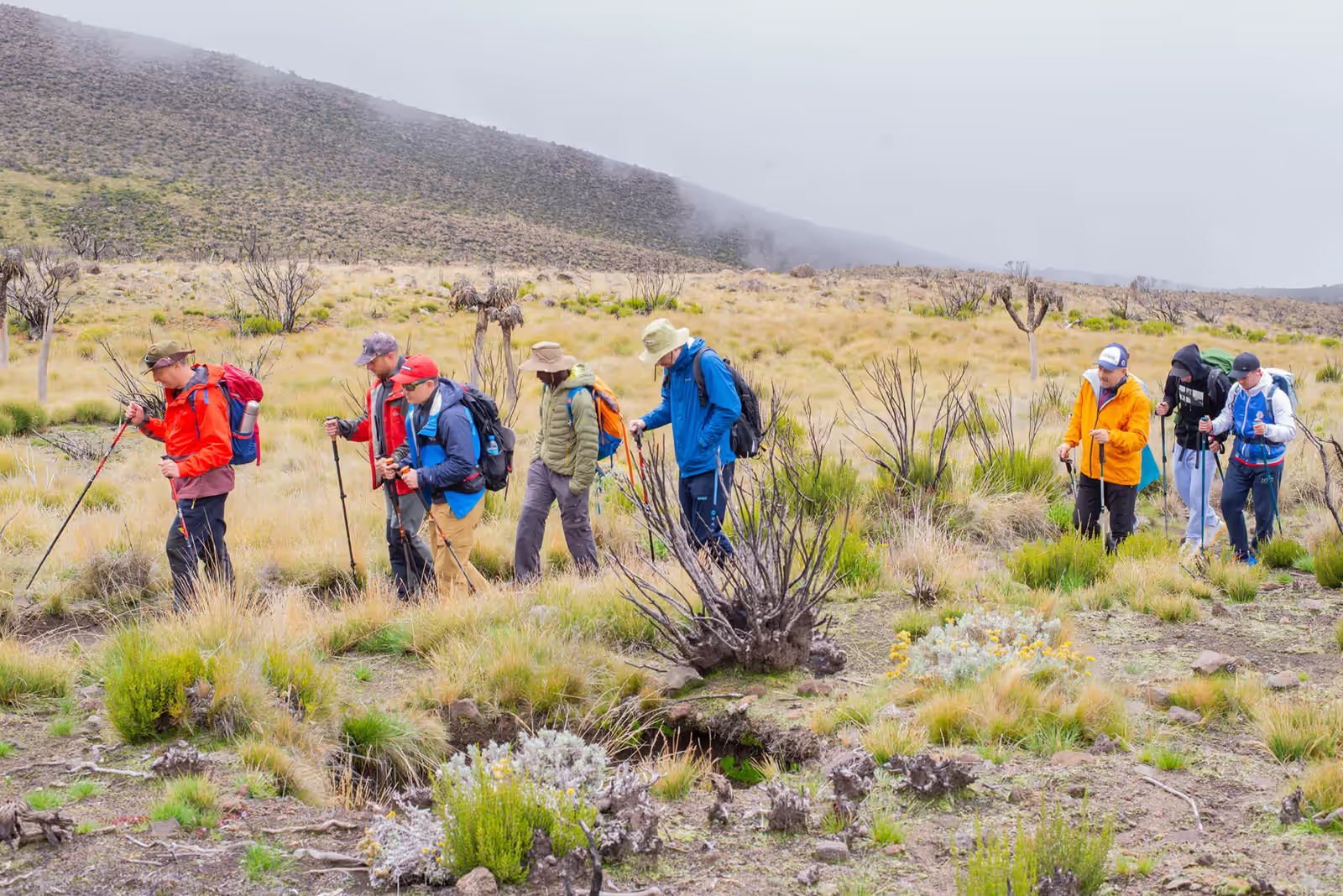
Route Length: 62km round trip | Typical Duration: 7-8 days | Starting Gate: Machame Gate (1,800m) | Success Rate: 75-90%
Why Climbers Choose Machame
Strongest advantages: - Stunning crater rim views and ridgeline vistas throughout - Strong acclimatization profile on 7-8 day itineraries - Varied terrain — rainforest, moorland, alpine desert, and a rock scramble - Less crowded than Marangu, with a more wilderness feel - High success rates: 75-80% on 7 days, 85-90% on 8 days
Realistic challenges: - Longer daily hiking than Marangu - More technically engaging terrain, including rock scrambling at Barranco Wall - Requires moderate fitness and properly broken-in boots - Some days involve significant elevation gain (over 1,000m in a single day)
The Complete 7-Day Machame Itinerary and Camps
Day 1: Machame Gate to Machame Camp (1,800m to 2,643m)
Hiking time: 5-7 hours through dense rainforest. The trail climbs steadily through tropical forest thick with vegetation and birdsong. Machame Camp sits in a rainforest clearing at 2,643m; night temperatures hover around 10-12°C. Despite an 843m elevation gain, most climbers sleep well here — excitement offsets any early altitude effects.
Day 2: Machame Camp to Shira Camp (2,643m to 3,840m)
Hiking time: 4-5 hours, gaining 1,197m — the steepest single-day gain on the route. Forest thins into open moorland, and Kilimanjaro's upper slopes come into view for the first time. Shira Camp sits at 3,840m with night temperatures of 5-8°C. Mild breathlessness and lighter sleep are normal here; hydrate aggressively tonight and tomorrow.
Day 3: Shira Camp to Barranco Camp (3,840m to 3,960m)
Hiking time: 7-8 hours but only 120m net elevation gain — a textbook acclimatization day. The route crosses the dramatic Shira Plateau, with views of Mawenzi and Kibo peaks. Most climbers notice their first real altitude symptoms today (headache, reduced appetite); the long, low-gain day exists specifically to counter that. Barranco Camp sits in a stunning amphitheater of rock formations.
Day 4: Barranco Camp to Karanga Camp (3,960m to 4,235m)
Hiking time: 4-5 hours, including the famous Barranco Wall — a 1,900m rock scramble that looks intimidating but is a straightforward, non-technical climb with fixed cables assisting on the steepest sections. Most groups clear it in 2-3 hours. Beyond the wall, the landscape opens into alpine desert. Karanga Camp sits at 4,235m; expect headache, mild nausea, and lighter sleep as oxygen drops to roughly 60% of sea level.
Day 5: Karanga Camp to Barafu Camp (4,235m to 4,673m)
Hiking time: 4-5 hours across scree, ash, and rock, gaining 438m. Night temperatures drop to around -10°C. Barafu — meaning "ice" in Swahili — is the final camp before summit night and hosts well over a hundred tents during peak season. Rest here is crucial; most climbers sleep poorly due to cold, altitude, and anticipation. Dinner is served early (around 4pm) ahead of a midnight departure.
Day 6: Summit Day — Barafu to Uhuru Peak and Down to Mweka Camp (4,673m to 5,895m to 3,068m)
Hiking time: 12-15 hours, the longest and hardest day of the trip. The summit push begins around midnight in complete darkness and -20°C to -30°C with wind chill. Pace is deliberately slow — "pole pole." Most climbers reach Uhuru Peak (5,895m) between 5:30 and 6:30am for sunrise, spending 5-20 minutes at the top before a long, knee-punishing descent — 1,605m down to Barafu, then on to Mweka Camp (3,068m) the same day.
Day 7: Mweka Camp to Mweka Gate (3,068m to 1,640m)
Hiking time: 3-4 hours through descending forest zones. Legs are exhausted, but the finish is close. At Mweka Gate, certificates are awarded and it's customary to tip guides and porters (roughly 10-15% of the total package cost, split among the crew).
Machame Route 7-Day Cost Breakdown (2026 Pricing)
Park Entrance Fees: $800-1,000 | Accommodation & Meals: $1,000-1,500 | Guide & Porter Services: $1,200-1,800 | Transportation: $250-400
Adding these together gives a realistic total, though exact pricing varies by operator and group size:
| Cost Category | 7-Day Machame Range | What's Included |
|---|---|---|
| Park entrance fees | $800-1,000 | Government fee, rescue services, environmental protection |
| Accommodation & meals | $1,000-1,500 | Tent camps, all meals, hot water |
| Guide & porter services | $1,200-1,800 | Certified guide, porter team (typically 2-3 per climber) |
| Transportation | $250-400 | Airport and gate transfers |
| Total per person | $3,300-4,700 | Full package |
For two climbers, expect roughly $6,600-9,400 combined; for a group of four, $13,200-18,800. Costs sit slightly below Lemosho and Northern Circuit due to the shorter itinerary, and above Marangu due to full tented camping logistics. If budget is your main driver, our budget Kilimanjaro guide covers legitimate ways to reduce these numbers without cutting safety corners.
Not included: international flights, Tanzania visa ($100-150), travel insurance with high-altitude evacuation cover, tips (10-15% of package cost), and personal gear.
Camp-by-Camp: What to Actually Expect
All Machame camps are tented — this is not a hut-based route. Porters carry, pitch, and strike your tent daily, and set up a communal dining tent for meals. Expect:
- Two-person dome tents with foam sleeping mats provided (bring your own sleeping bag rated to at least -15°C)
- A hot bowl of washing water delivered to your tent each morning and evening
- Simple but filling meals — porridge, eggs, and toast for breakfast; soup, rice, and vegetables for lunch and dinner
- Pit latrines at each camp, with private portable toilets available as a paid upgrade from most operators
- Progressively colder, windier, and more exposed camps as you climb — Machame Camp feels almost cozy; Barafu feels like a different planet
Success Rate Factors: What Actually Moves the Needle
- Itinerary length: 7-day success sits around 75-80%; adding one extra acclimatization day pushes 8-day itineraries to 85-90%
- Physical training: Roughly +15% probability with 4-6 months of dedicated preparation
- Professional guides: Roughly +20% probability with an experienced, certified guide team
- Proper acclimatization discipline: Hydration, slow pacing, and honest symptom reporting can add another +20-25%
Most failed summit attempts trace back to one of three causes: an itinerary too short for proper acclimatization, inadequate physical training, or climbers underestimating altitude and pushing too fast early in the trip.
Success Tips Specific to Machame
- Break in your boots fully before arrival — Day 1's rainforest descent-and-ascent terrain punishes untested footwear
- Treat Day 3's low elevation gain as a gift, not a wasted day — walk slowly and hydrate even though the terrain feels easy
- Take Barranco Wall at your own pace; it looks worse in photos than it feels in person
- Eat on Days 4-5 even without appetite — you're burning 4,000+ calories daily and need the fuel for summit night
- Pack every layer you own for summit night; -20°C to -30°C with wind chill is not an exaggeration
If Machame's pace or terrain gives you pause, it's worth comparing it against the gentler Marangu Route or the longer, higher-success Lemosho Route before booking.
Conclusion
The Machame Route delivers Kilimanjaro's best combination of scenery, achievable challenge, and strong success rates — provided you book at least 7 days, ideally 8, and train seriously beforehand. The cost sits comfortably in the mid-range among Kilimanjaro routes, and the camps, while basic, are well-organized and reliably run by experienced crews.
Ready to plan your Machame climb? Elem Adventures builds 7 and 8-day Machame itineraries with experienced guides and transparent, all-inclusive pricing.
Frequently Asked Questions
How much does the Machame Route cost for 7 days?
A 7-day Machame climb typically costs $3,300-4,700 per person, covering park fees, guides, porters, camping equipment, and meals. This excludes international flights, visa fees, tips, and personal gear, which typically add another $500-1,000.
Is 7 days enough on the Machame Route, or should I do 8?
Seven days is workable and posts a 75-80% success rate, but adding a single extra acclimatization day (typically at Karanga Camp) raises success to 85-90% for a relatively modest cost increase. If budget allows, 8 days is the better choice.
What are the camps like on the Machame Route?
All Machame camps are tented, not hut-based. Porters carry and pitch two-person dome tents at each site, with a communal dining tent for meals. Facilities are basic — pit latrines are standard, though private portable toilets are available as a paid upgrade.
How hard is the Barranco Wall on the Machame Route?
Barranco Wall looks intimidating from a distance but is a non-technical scramble with fixed cables assisting on the steepest sections. Most groups clear the 1,900m wall in 2-3 hours without ropes or climbing equipment.
What is the Machame Route summit success rate?
Roughly 75-80% on a 7-day itinerary and 85-90% on an 8-day itinerary. Success depends heavily on acclimatization pace, physical preparation, and guide quality rather than raw fitness alone.